Overview
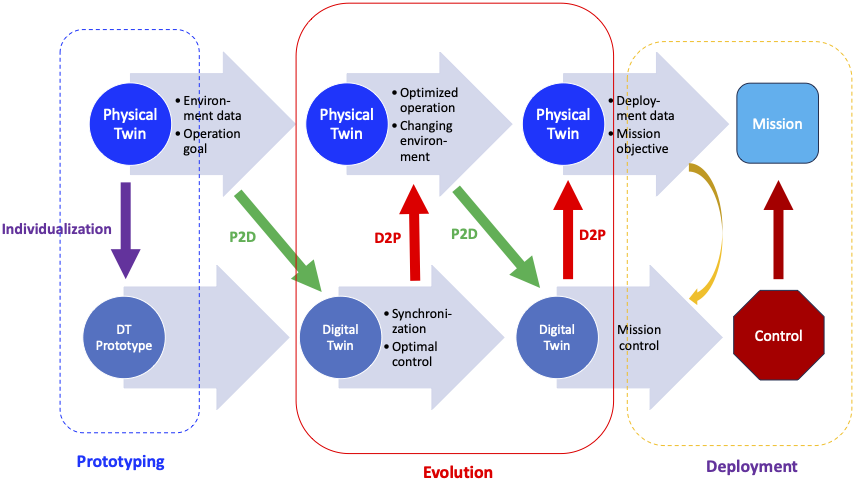
This definition differs from others in two distinct novel features. First, our DT is designed to adapt not only to environmental changes but also to situational changes and mission objective changes. Second, a self-learning AI (SLAI) component of our DT enables it to constantly ``learn'' from the asset (physical twin), the environment, and the mission objectives. Thus, our DT self-refines and improves its fidelity in the course of its life-cycle, producing better and more accurate real-time control and decision making. Our DT paradigm (shown below) emphasizes bidirectional flow of information and data between the physical asset and its DT. As the physical asset navigates the real world, all the data, including those that define the mission objectives and environment, are assimilated into its DT. This process is termed P2D (physical-to-digital). Meanwhile, the DT provides control and optimization decisions to the physical asset, a process termed D2P (digital-to-physical). As the physical asset evolves in physical time, its counterpart, the DT, evolves in virtual time. The P2D and D2P processes enable seamless interactions between the physical asset and its DT. The latter is updated by the changing data and environment via the P2D process; whereas the physical asset is adapted by the optimized decision from the DT via the D2P process.DT is a digital representation of a physical asset and its interactions with the environment, synchronized and continuously refined with data, driven by mission objectives, adapted to situational changes, with self-learning and self-improving AI capabilities, to provide real-time assessment, analysis, optimization and control, and decision-making.